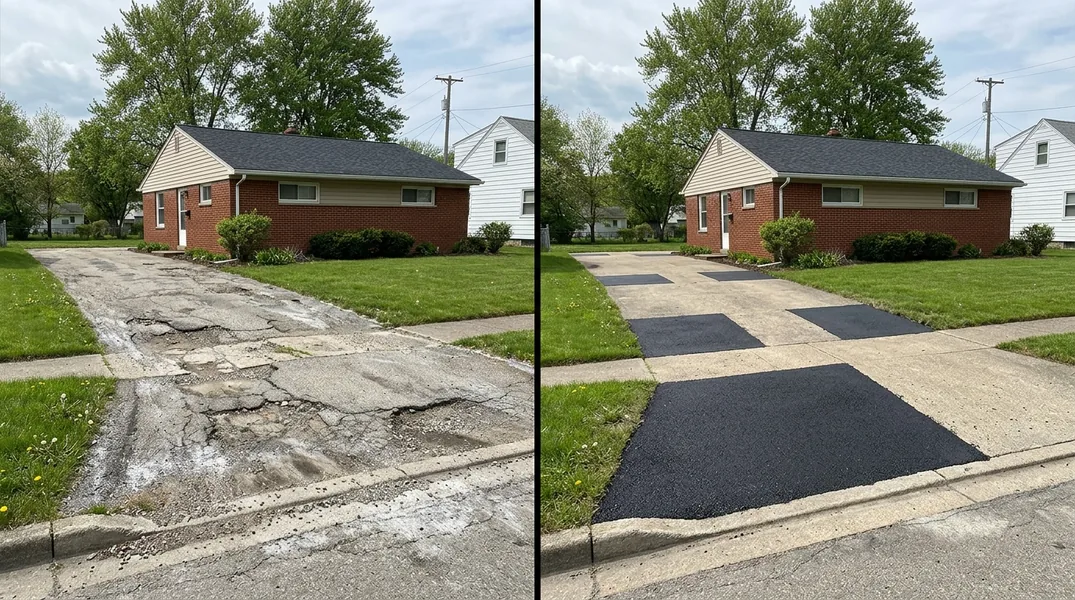
How Mahoning Valley Winters Create Potholes and Driveway Damage
Every spring, Youngstown homeowners face the same frustrating reality: potholes, cracks, and heaving asphalt. The culprit is not just the cold itself, but the freeze-thaw cycle that defines life in the Mahoning Valley. When winter temperatures plunge below freezing, any moisture trapped beneath or within your asphalt expands as it turns to ice. This expansion pushes upward on the pavement, creating stress that weakens the structure from below.
When temperatures rise above freezing, that ice melts and the ground settles unevenly. The asphalt above sinks into the gaps left behind, creating the characteristic potholes and depressions you see each March and April. Over multiple winter cycles, this damage compounds. What starts as a small crack becomes a pothole; what is a pothole one year becomes a section of severely compromised pavement the next. For homeowners in Boardman, Austintown, and surrounding areas, understanding this cycle is the first step toward making a smart repair decision.
The Case for Pothole Repair and Asphalt Patching
Pothole Repair and Asphalt Patching is often the first instinct for homeowners facing isolated damage. If your driveway is otherwise in good condition and you have only a few potholes or small cracks, patching can be a cost-effective short-term solution. A professional patch fills the damaged area, restores a level surface, and prevents water from seeping deeper into the base layer of your driveway. For many homeowners, this approach makes sense when damage is limited to one or two areas and the rest of the asphalt remains structurally sound.
However, it is important to understand what patching can and cannot do. A patch addresses the symptom, not always the underlying cause. If frost heave or poor drainage caused the pothole, that same issue may create new damage nearby or cause the patch itself to fail prematurely. Patches also tend to be visible and may not blend seamlessly with older asphalt, especially if the surrounding pavement has weathered and faded. Think of patching as a repair that buys you time, usually two to five years, before more extensive work may be needed. It is a reasonable choice if your driveway is relatively young or if you plan to address the larger problem in the near future.
When Full Repaving or Resurfacing Makes More Sense
If your driveway shows multiple potholes, widespread cracking, or signs of frost heave across large sections, Asphalt Resurfacing and Overlay or full replacement may be the wiser investment. Resurfacing involves applying a new layer of asphalt over the existing base, which is less disruptive and less expensive than complete removal and replacement. It works well when the underlying base is still solid but the top surface has deteriorated. Full repaving, on the other hand, removes the old asphalt entirely, inspects and repairs the base, and installs brand new pavement from the ground up.
The advantage of resurfacing or repaving is that it addresses the entire driveway at once, not just isolated spots. You get a uniform, attractive surface with no visible patches. More importantly, if your driveway is suffering from widespread frost heave or base failure, resurfacing or repaving gives you the opportunity to improve drainage and address the root cause of the damage. A professional contractor can install proper grading and drainage solutions that prevent future frost heave and extend the life of your new pavement by years. While the upfront cost is higher than patching, the long-term value is significantly better, especially if your driveway is more than 15 to 20 years old.
Evaluating the Age and Overall Condition of Your Driveway
One of the most important factors in deciding between patching and repaving is the age of your asphalt. If your driveway is less than 10 years old and damage is limited to one or two small areas, patching is usually the right choice. If your driveway is 15 to 20 years old or older, the asphalt has likely lost much of its flexibility and binding strength. In these cases, patching is often a temporary fix that merely delays the inevitable need for Driveway Repair or replacement.
Beyond age, look at the pattern of damage. If potholes and cracks are scattered across the entire driveway, resurfacing or repaving is more economical than patching multiple areas. If damage is concentrated in one or two spots, perhaps near a downspout or low point where water collects, patching combined with drainage improvements may solve the problem. Also consider how much time and money you plan to stay in your home. If you are selling within the next few years, a fresh new driveway can add curb appeal and value. If you plan to stay long-term, investing in quality work now will save money and frustration later.
Understanding Frost Heave Driveway Repair and Prevention
Frost heave is a specific type of damage caused by moisture in the soil beneath your driveway. When water freezes, it expands, pushing the asphalt upward. When it thaws, the ground settles unevenly, leaving cracks and depressions. Mahoning Valley winters create perfect conditions for frost heave because of the region's heavy precipitation and prolonged freezing temperatures. If your driveway shows signs of heaving (uneven sections, buckled areas, or a wavy appearance), simple patching will not solve the problem.
Proper frost heave repair requires addressing the moisture source. This might involve installing or improving drainage around your driveway, ensuring gutters direct water away from the pavement, or grading the surrounding soil so water does not pool near the edges. When you choose Asphalt Driveway Paving and Installation or resurfacing, a professional contractor will evaluate these factors and recommend solutions. In some cases, they may suggest a permeable base layer or additional gravel to improve drainage and reduce frost heave risk in future winters. This preventive approach costs more upfront but can add years to your driveway's lifespan.
Asphalt Driveway Paving and Installation Cost in Youngstown: What to Budget
Cost is naturally a major factor in the patch-versus-repave decision. Pothole patching typically costs between $150 and $500 per pothole, depending on size and depth. If you have three or four potholes, you might spend $500 to $2,000 on repairs. Asphalt resurfacing, which covers the entire driveway with a new layer, usually costs $1.50 to $3.00 per square foot, so a 500-square-foot driveway might run $750 to $1,500. Full Youngstown asphalt replacement typically costs $3.00 to $5.00 per square foot, making a complete job for that same driveway range from $1,500 to $2,500.
These are rough estimates, and actual pricing depends on your specific driveway size, condition, location, and the scope of work. A driveway with poor drainage or severe base damage may cost more to repair properly. The key is to think long-term. Spending $2,000 on a quality resurfacing that lasts 10 to 15 years is often a better value than spending $800 on patches that fail in two years and require repeated repairs. To understand your options and get an accurate estimate for your situation, contact Youngstown Asphalt Paving at (234) 230-7377 for a free estimate. A professional assessment will clarify whether patching or repaving is the right choice for your driveway.
Looking for a professional asphalt paving contractor in Youngstown? Youngstown Asphalt Paving responds fast for all your asphalt paving needs.
Get a Free Quote